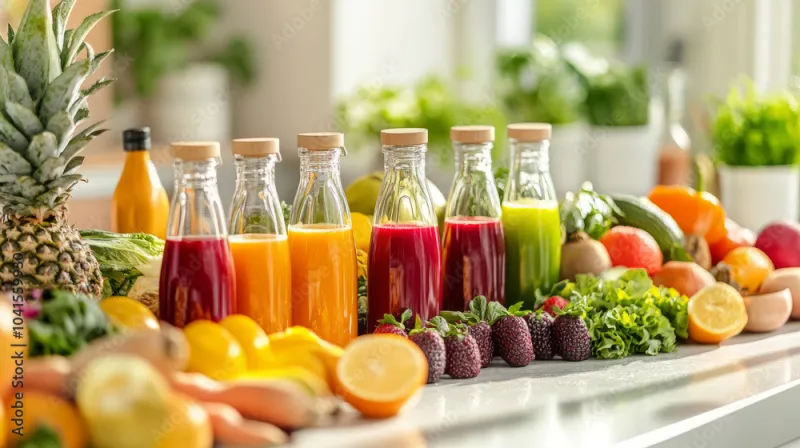
Better Together: The Ingredient Pairings That Make Your Cold-Pressed Juice Actually Work Harder

Photo: Audrey from Central Pennsylvania, USA, CC BY 2.0, via Wikimedia Commons
Ordering a cold-pressed juice feels like a solid health decision on its own. And it is — mostly. But there's a layer of nutritional strategy that most people never think about, one that could mean the difference between absorbing 5% of a key nutrient versus 50% of it. It's called nutrient synergy, and it's one of the more fascinating corners of nutritional biochemistry.
The short version: some ingredients are dramatically more effective when consumed alongside specific companions. Others actually compete with each other for absorption. Your juice order isn't just about flavor — it's a biochemical event, and knowing a few key pairings can make it a much better one.
What Is Nutrient Synergy, Exactly?
Nutrient synergy refers to the phenomenon where two or more compounds produce a combined effect that's greater than either would achieve alone. This happens through several mechanisms — one ingredient may enhance absorption of another, protect it from degradation, or activate metabolic pathways that make the second compound more bioavailable.
Bioavailability is the operative word here. It describes how much of a nutrient your body actually absorbs and uses, as opposed to what simply passes through. A juice can be packed with beneficial compounds on paper, but if your body can't access them efficiently, the impact is limited.
Here's where it gets interesting — and practical.
Fat-Soluble Vitamins + Any Fat Source
Vitamins A, D, E, and K are fat-soluble, meaning they require dietary fat to be absorbed properly. This is relevant to juice because many cold-pressed ingredients are rich in these vitamins — carrot (beta-carotene, a precursor to Vitamin A), leafy greens (Vitamin K), and citrus (which supports the absorption pathway for Vitamin E).
A 2012 study from Molecular Nutrition & Food Research found that consuming carotenoids — the pigments in orange and red produce — alongside fat increased absorption by up to 8x compared to fat-free consumption.
What this means for your order: If your juice is heavy on carrots, sweet potato, or leafy greens, consider pairing it with something that contains healthy fat — a small handful of nuts, a slice of avocado toast, or even a nut milk-based drink. Some juice bars, including Jrink, offer nut milk blends that can serve exactly this function.
Turmeric + Black Pepper: The Classic Duo
This pairing has gotten more mainstream attention than most, but it's worth explaining why it actually works. Curcumin — the active compound in turmeric — has impressive anti-inflammatory properties in research settings. The problem is its bioavailability is notoriously poor on its own. Studies show that curcumin is rapidly metabolized and eliminated before your body can make meaningful use of it.
Enter piperine, the active compound in black pepper. A landmark 1998 study published in Planta Medica found that piperine enhances curcumin absorption by approximately 2,000%. The mechanism involves piperine inhibiting certain liver enzymes that would otherwise break curcumin down too quickly.
What this means for your order: If you're reaching for a turmeric shot or any blend that features turmeric prominently, ask whether black pepper is included. At Jrink, several of our turmeric-forward blends already account for this — but it's worth checking, because without piperine, you're getting a fraction of the benefit.
Vitamin C + Iron: A Pairing Most People Skip
Iron deficiency is one of the most common nutritional gaps in the US, particularly among women. And while cold-pressed greens like spinach and kale do contain non-heme iron (the plant-based form), non-heme iron has notoriously low absorption rates — somewhere between 2% and 20% depending on what else you consume alongside it.
Vitamin C changes that equation significantly. It converts iron into a form that's more readily absorbed in the small intestine, and it also counteracts compounds called phytates that would otherwise block iron uptake. Research published in the American Journal of Clinical Nutrition found that Vitamin C consumed in the same meal as non-heme iron can increase absorption by up to 6x.
What this means for your order: A green juice that combines spinach or kale with citrus — lemon, orange, or grapefruit — isn't just a flavor decision. It's a nutritionally strategic one. If you're building your own blend, this pairing is worth prioritizing.
Lycopene + Other Carotenoids: The Tomato Principle
Lycopene, the compound that gives tomatoes and watermelon their red pigment, is associated with cardiovascular benefits and has shown promise in research on cellular health. Like beta-carotene, it's fat-soluble, but it also benefits from being consumed alongside other carotenoids.
Studies suggest that carotenoids in combination are more effective than any single carotenoid in isolation — they appear to work synergistically on antioxidant pathways. This is part of why whole-food approaches to nutrition consistently outperform isolated supplements in research.
What this means for your order: A juice that combines multiple colorful produce items — red, orange, yellow, and green — isn't just visually appealing. It's leveraging this multi-carotenoid synergy. Don't be afraid to mix color families.
Ginger + Any Anti-Inflammatory Ingredient
Ginger doesn't just add heat to a blend — it has a functional role as a bioavailability enhancer. Research shows that gingerols and shogaols (the active compounds in ginger) can increase gastric motility and enhance the absorption of various compounds by improving gut permeability and circulation to the digestive tract.
In practical terms, ginger helps your gut absorb more of whatever you're consuming alongside it. That makes it a smart addition to almost any functional juice blend, not just for flavor but as a delivery mechanism.
What this means for your order: Think of ginger as a force multiplier. If you're drinking something specifically for its health benefits — turmeric, greens, beet — adding ginger isn't just a flavor upgrade. It's a functional one.
A Few Pairings to Actually Avoid
Synergy works both ways. Some combinations actively compete:
- Calcium + Iron: High-calcium ingredients (like certain fortified nut milks) can inhibit iron absorption when consumed simultaneously. If you're specifically targeting iron intake, keep these separate.
- High-oxalate greens + calcium-rich foods: Spinach is high in oxalic acid, which can bind to calcium and reduce absorption of both. Rotating your greens matters.
The Takeaway
Your juice order is more than the sum of its ingredients — it's a system. Understanding how those ingredients interact gives you the ability to make choices that genuinely move the needle, rather than just checking a wellness box.
At Jrink, our blends are built with these relationships in mind. But now that you know the science, you can go further — ask questions, customize your order, and build combinations that work specifically for what your body needs. Cold-pressed is already a step ahead. Synergy is what takes it the rest of the way.